
Beads as Heirlooms
The question of beads as heirlooms arose during the interview process when a carefully dug collector feature yielded an earlier dated bead among the fill. Could the bead have been held so that it was ceremoniously passed along years after it was traded?
For this exercise, for a bead to be considered an Heirloom, it must first be found in a single bead context. Table 9 plots the dates and number of Single Bead Features, which are candidates for use as heirlooms.
Too, these single bead occurrences must have a feature association dating at least a generation later. We must reexamine the database for each of the major beads beginning in 1685.
Table 9 Single Bead/Heirloom Candidates
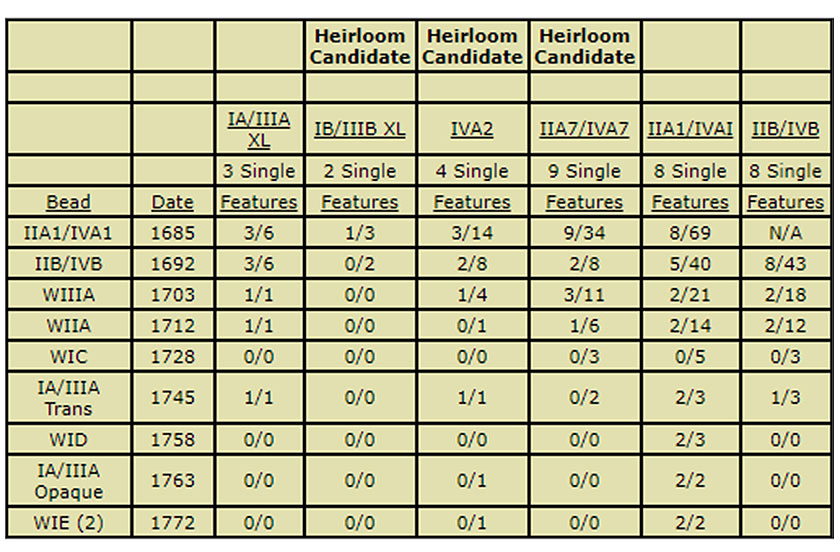
The left two columns of Table 9 provide the Major Beads beginning with IIA1/IVA1 and its trade date. The beads on the interior beginning with column 3 indicate the heirloom candidates. Moving to column 7, "IIA1/IVA1" we note moving down the table that there are 8 single features. Below that on the body of the table are x/y numbers. These indicate for the bead to the left (Column 1) that 'x' single features occurred / in 'y' available features. Continuing the example, see IIA1/IVA1 in Column 1 and read right across to IIA1/IVA1 (Column 7) intersection we note 8 features of 69 were single bead features. Moving down into the body of the table, we note 5/40 then 2/21 and so on. Looking again at Column 7 within the body from top down, we note that IIA1/IVA1 is in trade with a decreasing number of features over time, the 'y' number in our example. As time goes on the single bead occurrences or 'x' stop in 1728 with WIA and WIC and begin again with IA/IIIA Translucent. Once the single beads recur for IIAI/IVA1, they make up all or most of the features available-2/3, 2/3 then 2/2 and so on. In short, IIA1/IVA1 after its trade (and the time it took to become a feature) ended, it reemerged as single bead features, probable heirlooms. Remember the dates provided are the start of trade for any bead; time must be added for that bead to occur in a feature.
Looking again at Table 9, perhaps IA/IIIA XL also represents an heirloom. Most of the single examples of this bead and all of those of IIA1/IVA1 are white.